

 Ghana
 Côte d'Ivoire
 Senegal
 Kenya
 Egypt
 South Africa
 United States
 United Kingdom
 China
 India

What this means
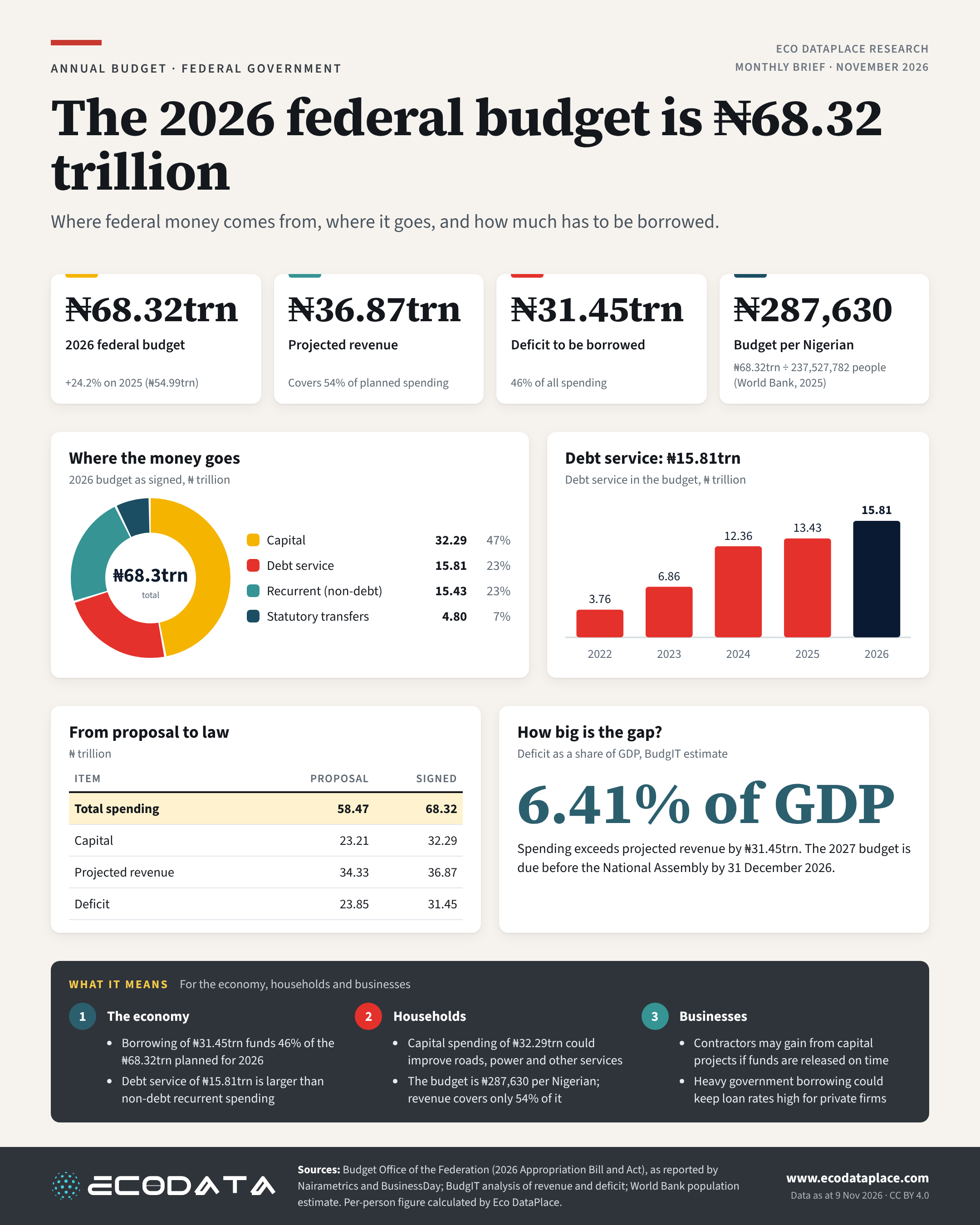
The 2026 budget as signed is ₦68.32trn, 24.2% more than in 2025. Projected revenue of ₦36.87trn covers about 54% of spending, leaving a ₦31.45trn deficit to be financed largely by borrowing. That works out to ₦287,630 per Nigerian (₦68.32trn ÷ 237,527,782 people, World Bank 2025).
For the economy
Debt service of ₦15.81trn exceeds non-debt recurrent spending, and BudgIT puts the deficit at 6.41% of GDP. In early November the President asked the Senate to approve external borrowing of ₦10.79trn to help fund the budget (Nairametrics, 4 Nov 2026).
For households
Capital spending of ₦32.29trn could improve roads, power and other services if released on time. Heavy borrowing and debt costs leave less room for other spending.
For businesses
Contractors may benefit from capital projects, though release delays are common. Large government borrowing could keep interest rates high for private firms. The 2027 budget is due before the National Assembly by 31 December 2026.
For information only; not investment or tax advice.