

 Ghana
 Côte d'Ivoire
 Senegal
 Kenya
 Egypt
 South Africa
 United States
 United Kingdom
 China
 India

What this means
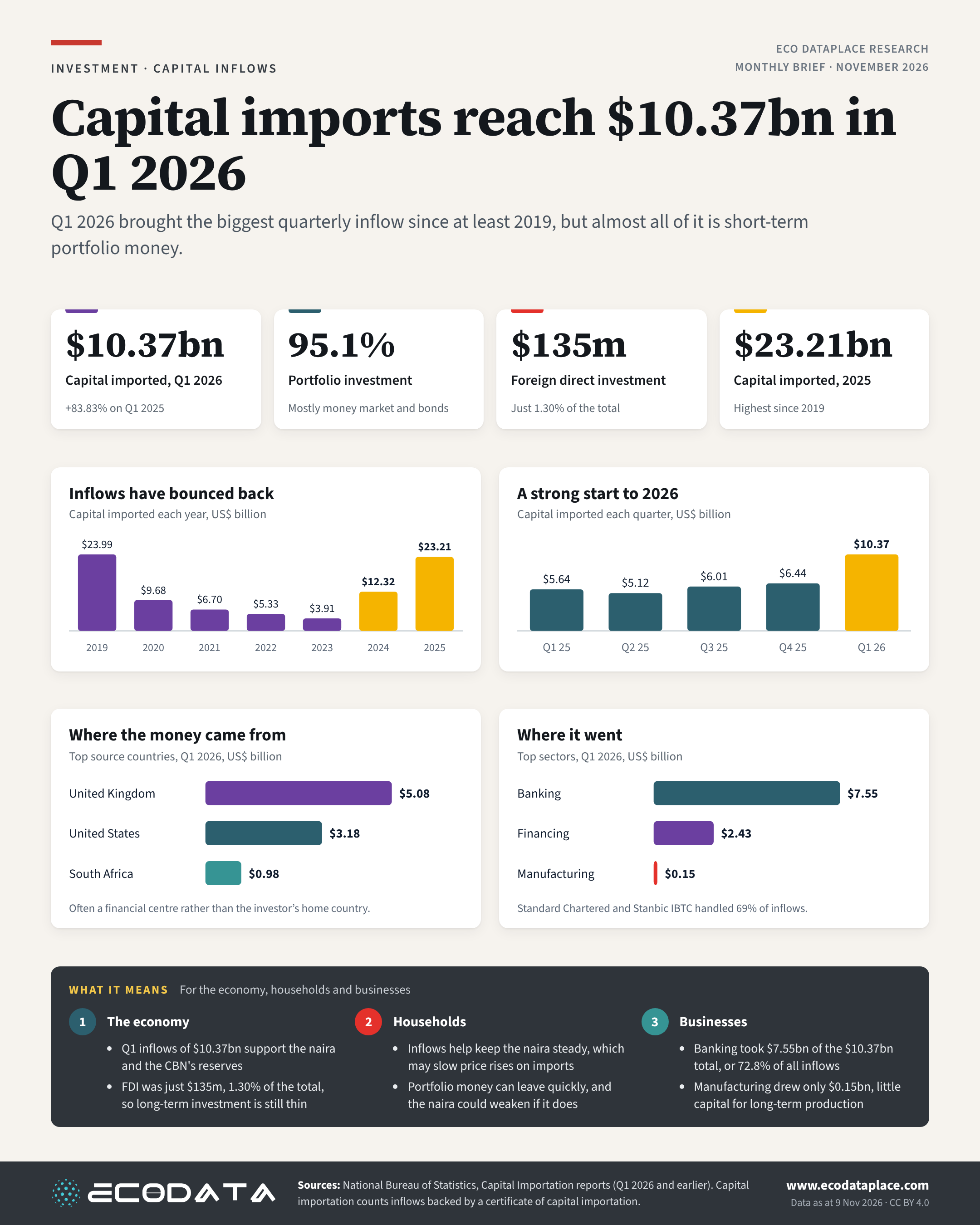
Capital importation reached $10.37bn in Q1 2026, the largest quarterly inflow since at least 2019 and 83.83% more than a year earlier. Almost all of it, 95.1%, was portfolio money in the money market and bonds; foreign direct investment was just $135m.
For the economy
The inflows support the naira and the CBN’s reserves. Total capital imported in 2025 was $23.21bn, close to the 2019 level. Long-term investment remains thin, which limits the boost to future output. The NBS has not yet published its Q2 2026 report.
For households
Inflows help keep the exchange rate steady, which may slow price rises on imported goods. Portfolio money can leave quickly, however, and the naira could weaken if it does.
For businesses
Banking took $7.55bn, 72.8% of the total, while manufacturing drew only $0.15bn. The United Kingdom ($5.08bn) and the United States ($3.18bn) were the main sources, often as financial centres rather than investors’ home countries.
For information only; not investment or tax advice.