

 Ghana
 Côte d'Ivoire
 Senegal
 Kenya
 Egypt
 South Africa
 United States
 United Kingdom
 China
 India

What this means
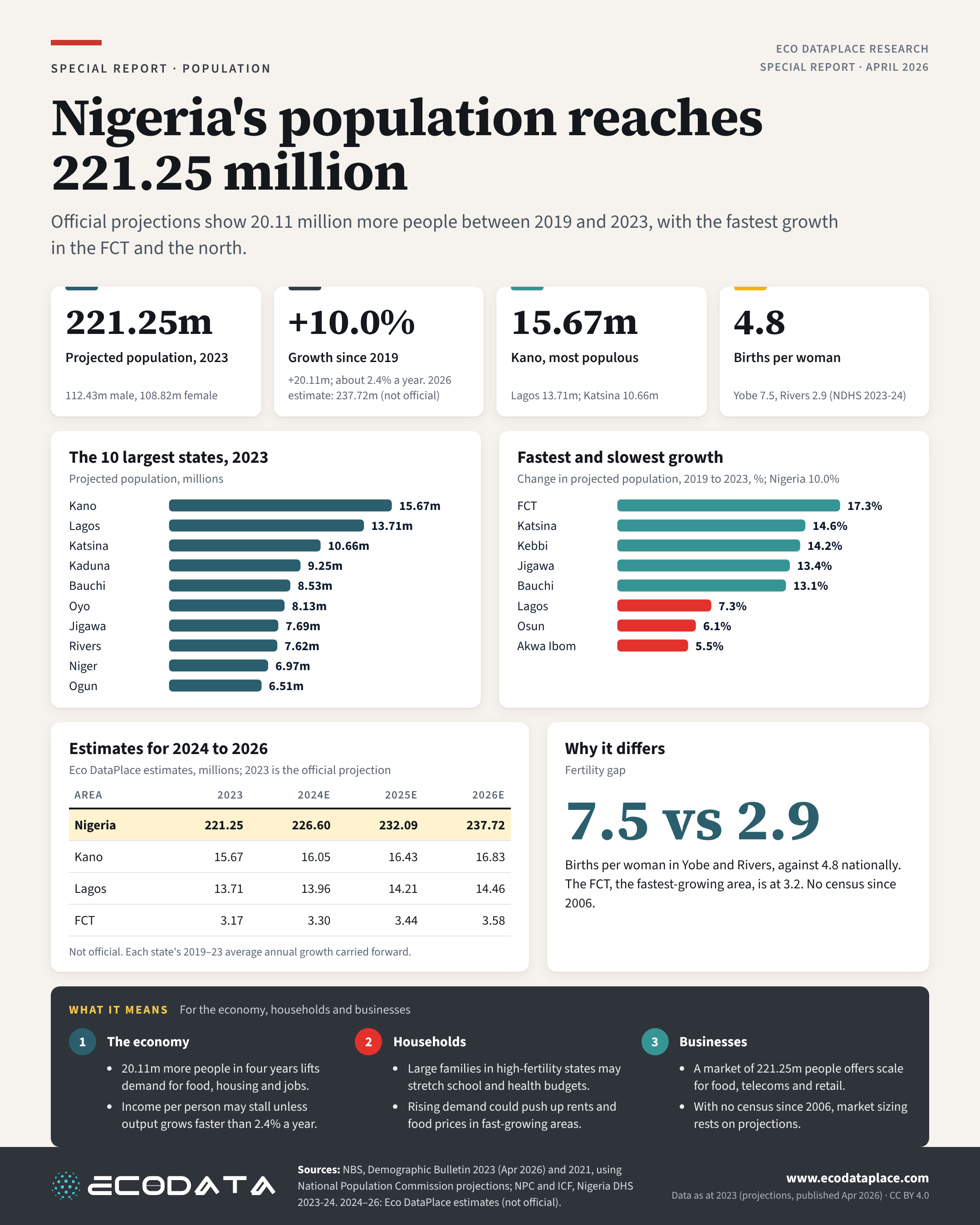
Nigeria’s projected population reached 221.25 million in 2023, up 10.0% from 201.14 million in 2019, according to the NBS Demographic Bulletin 2023. Kano is the most populous state (15.67 million), followed by Lagos (13.71 million) and Katsina (10.66 million). Growth was fastest in the FCT (17.3%) and northern states such as Katsina, Kebbi, Jigawa and Bauchi, and slowest in Akwa Ibom (5.5%).
There are no official figures after 2023. Carrying each state’s 2019–2023 average growth forward, Eco DataPlace estimates about 237.72 million in 2026; at 2023’s slower 2.06% growth, it would be about 235.21 million. These are not official figures.
For the economy
Adding 20.11 million people in four years raises demand for food, housing, power, schools and jobs. With the population growing by about 2.4% a year, output must grow faster than that for income per person to rise.
For households
Fertility remains high: 4.8 births per woman nationally, from 7.5 in Yobe to 2.9 in Rivers (NDHS 2023-24). Larger families may stretch school, health and food budgets, and rising demand could push up rents in fast-growing areas.
For businesses
A market of 221.25 million people offers scale for food, telecoms, retail and housing. With no census since 2006, firms may need to check local data before investing.
For information only; not investment or tax advice.