

 Ghana
 Côte d'Ivoire
 Senegal
 Kenya
 Egypt
 South Africa
 United States
 United Kingdom
 China
 India

What this means
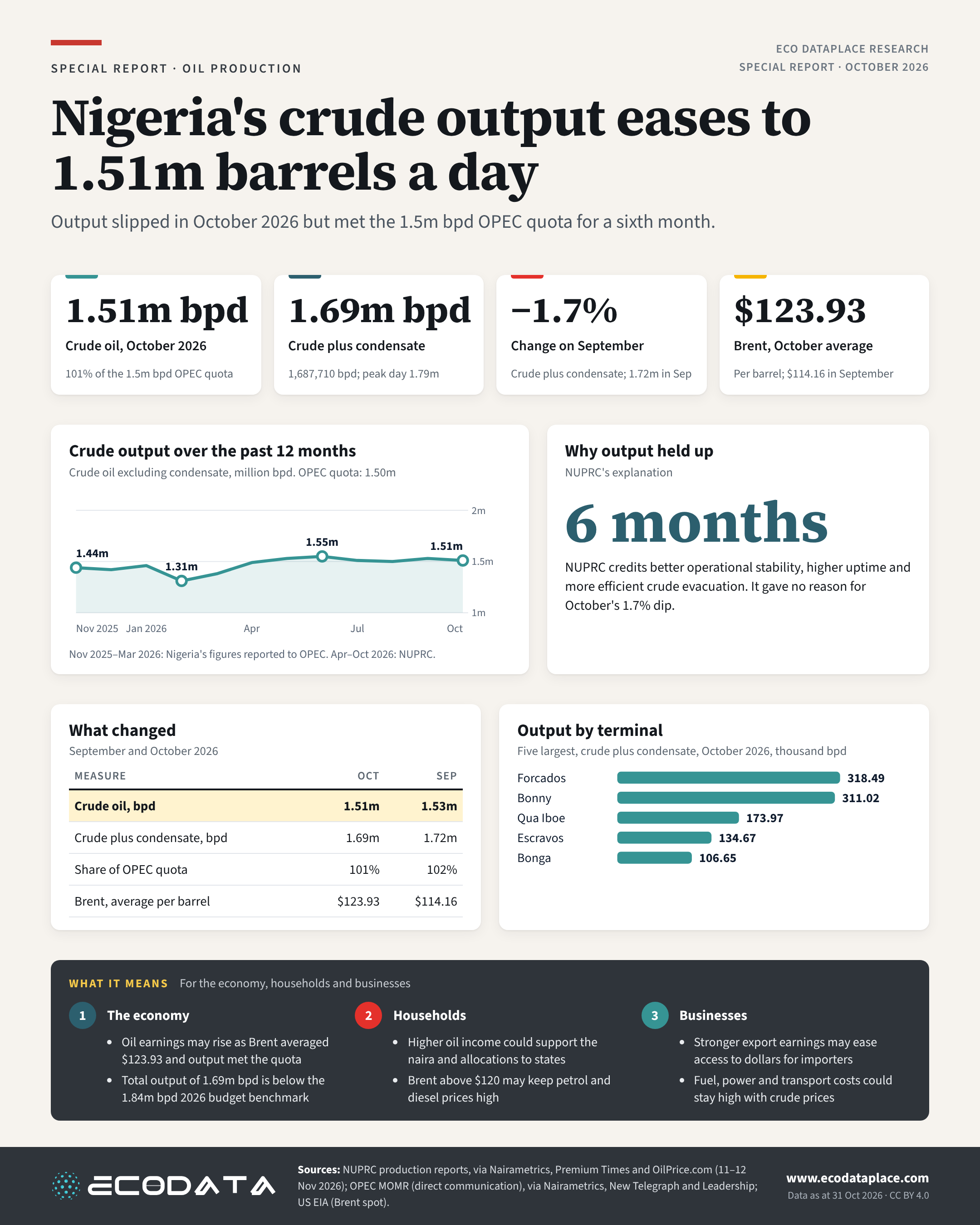
Nigeria produced an average of 1.51 million barrels a day (bpd) of crude oil in October 2026, down from 1.53 million in September, according to the Nigerian Upstream Petroleum Regulatory Commission (NUPRC). Including condensate, output was 1,687,710 bpd, 1.7% lower than in September. Crude output still met the 1.5 million bpd OPEC quota for a sixth month, while Brent averaged $123.93 a barrel, up from $114.16.
For the economy
Steady volumes and high prices may lift oil earnings, which supply most of Nigeria’s export income and support the naira and reserves. Total output of 1.69 million bpd remains below the 2026 budget benchmark of 1.84 million bpd, which limits how much of the price gain reaches government revenue.
For households
Higher oil income could support federal allocations to states and local governments. At the same time, Brent above $120 a barrel may keep petrol, diesel and transport costs high.
For businesses
Stronger export earnings may improve the supply of dollars for importers. Firms that rely on diesel, generators and haulage could face continued cost pressure while crude prices stay elevated. Forcados (318,490 bpd) and Bonny (311,020 bpd) remained the largest terminals.
For information only; not investment or tax advice.